A beginner who has understood the rules soon hits the same wall: scanning gives nothing more, and apparently all that is left is to guess. You must never guess at Sudoku. What is missing at that point is these six techniques.
They have two things in common. They all reason inside a single unit, row, column or box. And they almost never place a digit: they eliminate one, and it is those eliminations that make the next ones fall.
🎯 What they make possible
Taken together, these six techniques solve the vast majority of grids up to level 5, without ever resorting to trial and error. This is the foundation: the advanced techniques, X-Wing and beyond, are useless until it is in place.
| Grid level | What is enough |
|---|---|
| 1 to 2 | Scanning alone |
| 3 to 4 | Naked pairs, hidden pairs |
| 5 | The six techniques on this page |
| 6 and above | The advanced techniques, which assume these are in place |
None of these six techniques is visible on a grid where the candidates are not written down. If you still hesitate to note them, start there: it is not cheating, it is the condition of access to the whole logic of the game.
📚 The path, in order
Order matters. Each technique builds on the reflex formed by the previous one, and skipping a step makes the next far harder than it is.
Naked pairs
Two cells in the same unit holding only the same two candidates. Those two digits are reserved for them and vanish from every other cell of the unit.
When to use it: As soon as you note your candidates. It is the first technique that yields a result without hunting for where to place a digit.
Read the full tutorial →Hidden pairs
Two digits appearing in only two cells, while those cells also hold other candidates. You clear out the inside of those two cells.
When to use it: When the naked pair gives nothing more. It stays invisible until you count the places of each digit.
Read the full tutorial →Naked triples
Three cells whose combined candidates come to only three digits. None of them needs to carry all three, which is the most common mistake.
When to use it: On units where two cells are no longer enough. The reasoning is that of the naked pair, with one cell more.
Read the full tutorial →Hidden triples
Three digits confined to three cells of the same unit. You eliminate every other candidate from those three cells.
When to use it: The most demanding of the six, and the one still available when everything else is stuck.
Read the full tutorial →Box reduction
When all the places of a digit on a line fall inside a single box, that digit leaves the rest of the box.
When to use it: After exhausting pairs and triples. It is the first technique that makes two units talk to each other.
Read the full tutorial →Pointing pairs
The mirror of box reduction: a digit confined to aligned cells within a box leaves the rest of the row or column.
When to use it: At the same time as box reduction. You always eliminate in the unit you did not read.
Read the full tutorial →These six techniques are exactly those of the workbook SUDOKU, Les 6 techniques de base, with 100 exercises to work through them one by one. See what it contains ↓
🎬 Understanding them is not enough
This is where most players stall. You read the six tutorials in one evening, you nod along, and in front of a real grid you still see nothing. Understanding a technique and spotting it are two different skills, and the second is only acquired through repetition.
▶ The training method in 2 minutes.
Did you find this video useful? More than 120 free Sudoku tutorials are waiting on the channel, with an English audio track and subtitles.
▶ Subscribe for freeOne exercise a day, three months
The principle of the workbook Les 6 techniques de base rests on this idea. Each exercise presents a grid part-way through solving, not a blank grid: your job is not to solve it, but to spot the technique that applies and say which candidates to eliminate.
This is exactly the training that is missing. Three things make it usable on your own:
- A hint you can consult at any time, so you never stay stuck
- The detailed solution of every exercise at the end of the workbook
- A score table, to locate your progress instead of guessing at it
At one exercise a day, the 100 exercises cover a little over three months. That is the pace that turns understanding into reflex.
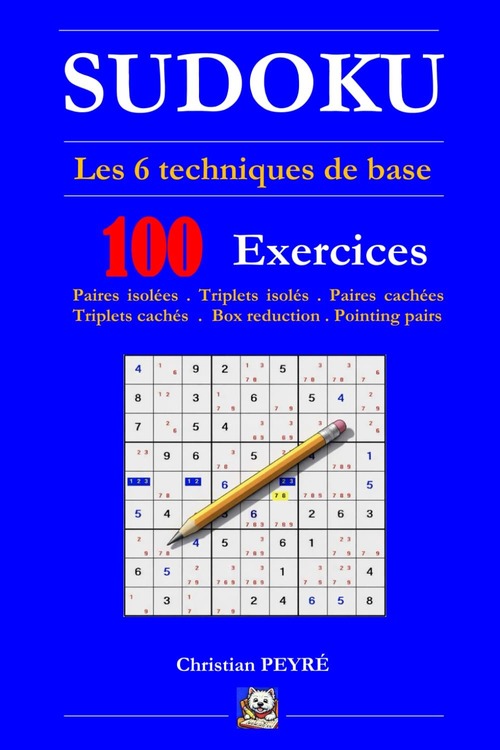
SUDOKU, Les 6 techniques de base
100 exercises designed for one thing: making the six techniques on this page automatic.
- 100 grids part-way through solving, not blank grids. Your job is not to solve, but to spot the technique that applies and say which candidates to eliminate.
- A hint you can consult at any time, so you never stay stuck on an exercise.
- The detailed solution of every exercise, at the end of the workbook.
- A score sheet, to locate your level instead of guessing at it.
- One exercise a day : in a little over three months, the six techniques hold no more secrets.
Paperback, available on Amazon. The book is in French. Sudoku Solver Pro comes free with the 40 techniques memento.
⚙️ And after these six
When these six techniques unlock nothing more, the grid is level 6 or beyond, and you have to change scale. The advanced techniques no longer reason within a single unit but across the whole grid: X-Wing, Y-Wing, W-Wing, XYZ-Wing, SwordFish and Sashimi X-Wing.
They all rest on the same work of reading candidates. That is why there is no point tackling them before the first six are automatic.
❓ Frequently asked questions
Naked pairs, hidden pairs, naked triples, hidden triples, box reduction and pointing pairs. Together they solve the vast majority of grids up to level 5, without ever guessing.
In the order of this page. Naked pairs first, because they are visible and immediate. Hidden pairs next, which require counting. Then the triples, which repeat the same logic with one cell more. Box reduction and pointing pairs last, because they bring two units into play at once.
Yes, without exception. None of these six techniques is visible on a grid where the candidates are not written down. It is not cheating, it is the condition of access to the whole logic of Sudoku.
Understanding the six takes an evening. Making them automatic takes repeated practice: at one exercise a day, count on about three months for them to become reflexes.
Move on to the advanced techniques: X-Wing, Y-Wing, W-Wing, XYZ-Wing, SwordFish and Sashimi X-Wing. They all rest on the same work of reading candidates, but reason on the scale of the whole grid.
📋 In short
Les 6 techniques de base
- What they share: they reason inside a single unit and eliminate candidates
- What they make possible: solving most grids up to level 5 without guessing
- The prerequisite: noting your candidates, without which nothing is visible
- The order: naked pairs, hidden pairs, naked triples, hidden triples, box reduction, pointing pairs
- Turning it into reflex: repetition, one exercise a day
- What comes next: the advanced techniques, from level 6 onwards