You have mastered the six basic techniques, you note your candidates without thinking, and yet a level 8 grid stops you dead. That is normal: a floor is missing.
The advanced techniques do not replace the previous ones, they add to them. A hard grid is still 90% solved with the basic techniques; these six serve to cross the two or three blockages that remain, and without them the grid cannot be crossed except by guessing.
🧭 Two families, not six isolated techniques
This is the key to not getting lost. These six configurations fall into two groups that do not reason in the same way at all.
| Family | Principle | Techniques |
|---|---|---|
| The fish | A single digit, whose places you follow across rows and columns | X-Wing, Sashimi, SwordFish |
| The wings | Several digits, in two- or three-candidate cells linked together | Y-Wing, XYZ-Wing, W-Wing |
The fish are counted : you list the places of a digit and see whether they fit into a small number of columns. The wings are reasoned case by case : you assume a value, look at what it entails, and find that the same conclusion falls in every case.
Do not tackle these techniques before making automatic the six basic techniques. They assume candidates kept rigorously up to date, and a single candidate error makes every configuration below wrong.
📚 The path, in order
This order is not that of the book, which presents them by family. It is the one that asks the least effort: each technique reuses the reflex built by the previous one.
X-Wing
A digit whose places on two rows fall in the same two columns. It then leaves the rest of those columns.
When to tackle it: The gateway to the fish family. It is also the only advanced configuration you end up seeing at a glance.
Read the full tutorial →Sashimi X-Wing
An X-Wing with a missing corner, replaced by a fin confined to a single box. Eliminations are limited to the intersection of the column and that box.
When to tackle it: Right after the X-Wing. It teaches you to stop discarding an imperfect configuration, a reflex that serves everywhere else.
Read the full tutorial →SwordFish
The X-Wing over three rows and three columns. No row needs three places: only the union of the columns counts.
When to tackle it: When the X-Wing gives nothing more. It is not spotted by eye, it is counted.
Read the full tutorial →Y-Wing
A bivalue pivot and two bivalue pincers that see it, sharing a common digit. That digit leaves the cells seeing both pincers.
When to tackle it: The entry to the wing family. It is the first technique that reasons by cases rather than by counting.
Read the full tutorial →XYZ-Wing
A Y-Wing whose pivot carries three candidates. Since it may itself hold the target digit, the cleared cells must see all three cells.
When to tackle it: Immediately after the Y-Wing, since it is the same shape. Careful, the elimination rule changes.
Read the full tutorial →W-Wing
Two identical bivalue cells that do not see each other, joined by a strong link elsewhere in the grid.
When to tackle it: Last, because it requires spotting a strong link, a notion the previous five never use.
Read the full tutorial →These six techniques are exactly those of the workbook SUDOKU, 6 Techniques élaborées, with 100 exercises to work through them one by one. See what it contains ↓
🎬 Understanding them is not enough
The gap is even wider than with the basic techniques. An X-Wing read in a tutorial looks obvious; the same X-Wing in a level 8 grid, drowned among three hundred candidates, cannot be seen. Spotting is a skill distinct from understanding, and it is only acquired through repetition.
▶ The training method in 3 minutes.
Did you find this video useful? More than 120 free Sudoku tutorials are waiting on the channel, with an English audio track and subtitles.
▶ Subscribe for free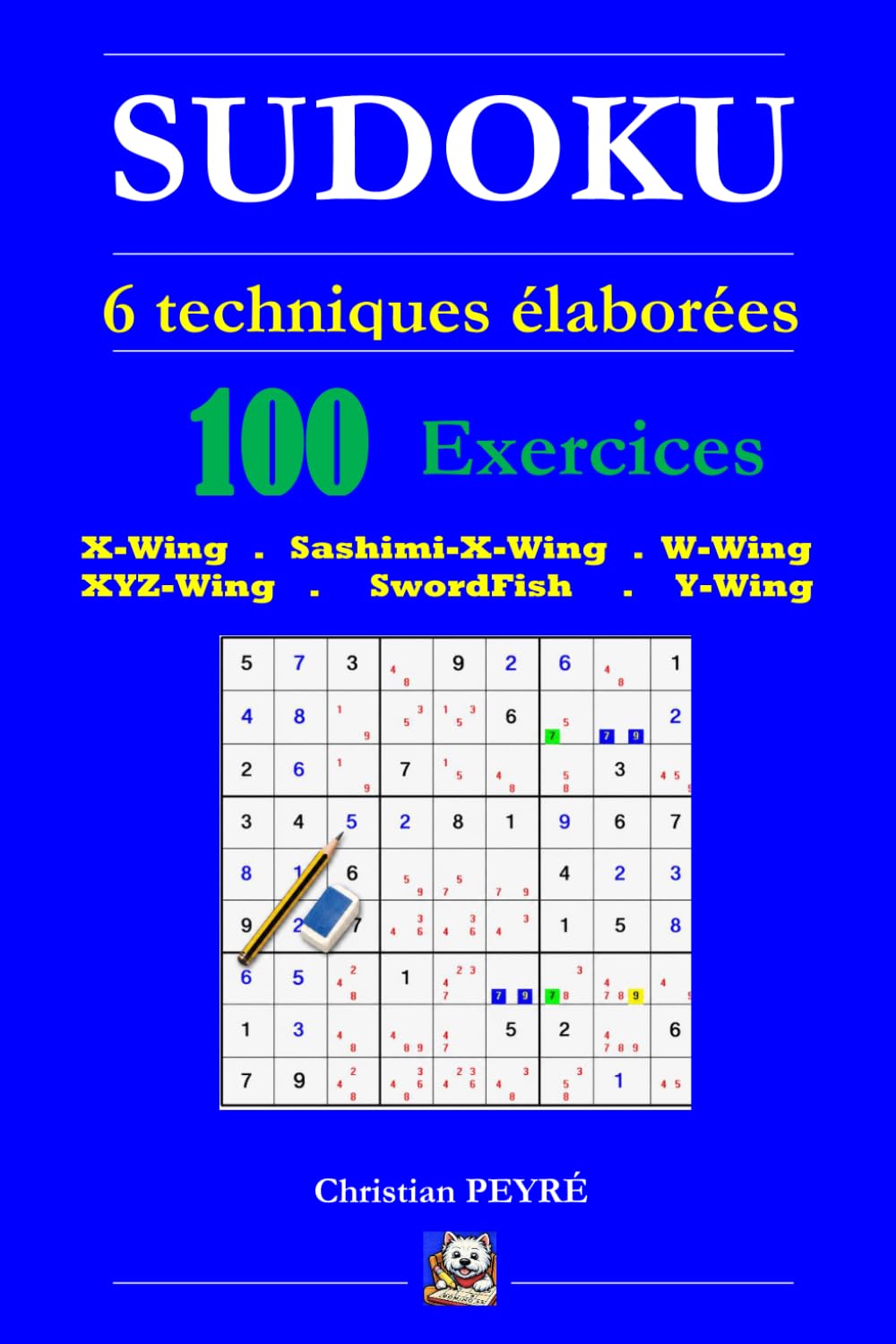
SUDOKU, 6 Techniques élaborées
100 exercises devoted to the six configurations on this page, from the X-Wing to the SwordFish.
- 100 grids part-way through solving, not blank grids. Your job is not to solve, but to locate the technique and propose the candidates to eliminate.
- A hint you can consult at any time, which counts double on configurations this hard to spot.
- The detailed solution of every exercise, at the end of the workbook.
- A score sheet, to locate your level in the advanced techniques.
- One exercise a day : in three months, these six techniques hold no more secrets.
Paperback, available on Amazon. The book is in French. For the basic techniques, the matching workbook follows the same principle.
❓ Frequently asked questions
The X-Wing, the Sashimi X-Wing, the SwordFish, the Y-Wing, the XYZ-Wing and the W-Wing. They fall into two families: the fish, which work on a single digit spread across rows and columns, and the wings, which link cells with two or three candidates.
When the six basic techniques unlock nothing more, which happens from level 6 grids onwards. Tackling them earlier is counterproductive: they assume a rigorous reading of candidates, which is only acquired with the basic techniques.
Yes, without exception. The advanced techniques do not replace the basic ones, they add to them. A level 8 grid is 90% solved with the basic techniques; the advanced ones serve to cross the two or three blockages that remain.
The X-Wing, by far. It is the most frequent in real grids and the easiest to spot. The Y-Wing comes next. The SwordFish and the Sashimi are rarer but unlock grids where nothing else works.
Understanding them takes a few evenings. Spotting them in a real grid is another matter, and that is only acquired through repetition: at one exercise a day, count on about three months.
📋 In short
The 6 advanced techniques
- Two families: the fish are counted, the wings are reasoned case by case
- When: from level 6, when the basic techniques give nothing more
- The prerequisite: the six basic techniques, learnt and automatic
- The order: X-Wing, Sashimi, SwordFish, then Y-Wing, XYZ-Wing, W-Wing
- The most useful: the X-Wing, by far the most frequent in real grids
- Turning it into reflex: repetition, one exercise a day
🧠 And after the six?
From level 9, these six configurations are no longer enough. The baton passes to the X-Cycles, which follow a single digit along a chain alternating strong and weak links. Good news: the X-Wing you have just learnt is already one, the shortest possible.
← Back to the Domino33 home page