Copying out a grid to redo it cleanly, practising pencil marks with room to write, drilling one technique without ruining a magazine: a blank grid comes in useful more often than you would think.
Here are four A4 sheets, free to download and print. They carry the site address and the channel, nothing else.
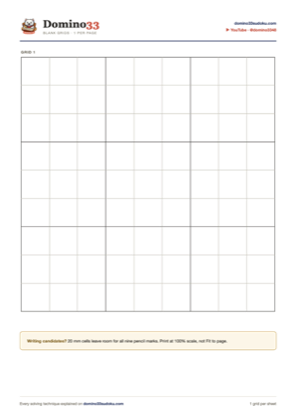
1 grid per page
The largest format, with 20 mm cells. The most comfortable for pencil marks, and the most legible if you need things big.
↓ Download the PDF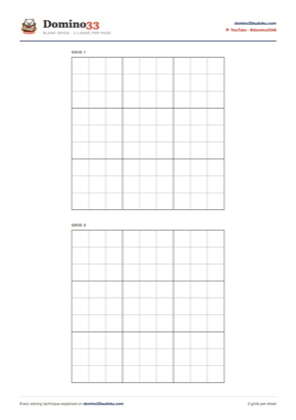
2 large grids
Wide cells, meant for writing candidates comfortably in pencil. The format to reach for when you are drilling a technique.
↓ Download the PDF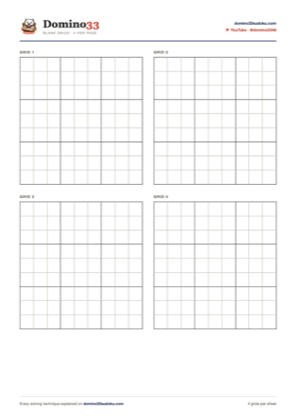
4 grids per page
The right balance between writing room and number of grids. The most versatile of the four.
↓ Download the PDF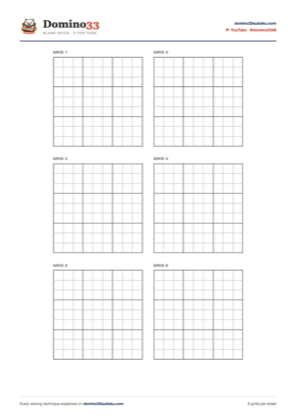
6 grids per page
A compact format, for copying out plenty of grids without wasting paper. Ideal on the move.
↓ Download the PDF🖨️ Printing them properly
In the print dialog, pick 100 % scale or Actual size, and above all not Fit to page. That last option shrinks the sheet and with it the cells, which is exactly what you are trying to avoid when you intend to write candidates.
✏️ What to use them for
Pencil marks with room to breathe
This is the first use, and the whole point of the two-large-grids sheet. Nine small digits in one cell takes room. And if you still hesitate to write them, it is not cheating, quite the opposite.
Restarting a grid you spoiled
One wrong deduction early on and everything collapses twenty cells later. Copying the starting grid onto a clean sheet lets you begin again properly, without the old crossings-out steering your thinking.
Drilling one technique
Take a position from one of the tutorials, copy it out, and apply the technique until the move becomes automatic. That is how the reflex is built, far more than by reading.
📐 Choosing a cell size
This is the only real question to settle, and it depends entirely on what you intend to write in the cells.
If you only ever write the final digit, any format will do, and six grids per page will save you paper. But as soon as you write candidates you need room for up to nine small digits in a single cell, in three rows of three. Below 12 millimetres the writing stops being legible and you end up giving up on candidates altogether, which costs you half the techniques.
The one-grid-per-page sheet gives 20 millimetre cells. It is the most comfortable format, and the only one really suited to anyone who needs large characters.
🖊️ Which paper to print on
Ordinary 80 gsm paper is plenty. Two things matter more than the paper quality:
- Print in black and white. The sheets are designed to stay perfectly legible without colour, so you spare your cartridges.
- Avoid very thin paper. An eraser on 60 gsm eventually goes through the sheet, and you will be erasing a lot.
✍️ Building your own puzzles
A blank grid is also a tool for making puzzles. Start from a complete, valid grid, remove digits one at a time while checking each time that exactly one solution remains, and you have a puzzle of your own.
It is an excellent exercise: building a grid forces you to understand why some givens are indispensable and others redundant. Plenty of solvers improve faster by creating than by solving.
👨🏫 In class, in a club, at home
These sheets are free to use. Print and photocopy them as much as you need, for a workshop, a Sudoku club, a classroom or a care home, without asking us anything.
The six-per-page format is the most economical for handing out to a group. The one-per-page format is the most legible for an audience that needs large characters.
❓ Frequently asked questions
They let you copy out a grid to redo it without the smudges of the first attempt, practise writing candidates with enough room, and build your own puzzles. They are also the cleanest way to drill one technique without ruining a magazine.
Yes. All four PDFs are free to download and print, with no sign-up and nothing asked in return. Print them as often as you like, including for a club or a classroom.
One grid per page if you write candidates: its 20 mm cells are the most comfortable. Two large grids for the same use while saving paper, since the cells still take nine pencil marks. Four per page for everyday solving. Six per page if you copy out a lot of grids and want to save paper.
The sheets are A4. In the print dialog choose 100 percent scale or Actual size, not Fit to page, otherwise the margins shrink and the cells come out smaller than intended.
Yes. The four sheets here are standard 9x9 grids in A4 PDF, downloadable with no sign-up and nothing asked in return. Click the download button for the format you want, then print.
Yes, they are free to use. Print and photocopy them as many times as you need for a workshop, a Sudoku club, a classroom or an institution, with no permission to ask for.
At least 12 millimetres, below which the nine small digits in a cell stop being legible. The one-grid-per-page sheet gives 20 millimetre cells, which is the most comfortable format.
📘 Go further with the Domino33 books
The sheets give you the paper. The Domino33 memento gives you the method, all 40 techniques step by step, written in English, with the Sudoku Solver Pro software included.